
03 // Industry Use Cases
Airlines & Aviation: Low-Moisture Carpet Care for Cabins, Lounges, and Gates
Aircraft cabins punish water and airports never close. A 12-inch counter-rotating brush and a light encapsulator fit both schedules, as long as the chemistry is approved for the aircraft.
At a glance
- Dry time
- ~40 minwith CRB Dry Compound
- Moisture method
- Low-moisture encapsulation / dry compound
- Recommended brush
- Standard BlueSoft Gray
- Ideal machine
- TM3 (12") cabin aisles · TM4 (15") / TM5 (20") terminals
The 3-step process
- 1
Apply compound or encap pre-spray
A light, even application. No flooding, no soaked backing.
- 2
Counter-rotating cylindrical agitation
Two brushes turn against each other, lifting the pile and working chemistry in.
- 3
Lift soil & back in service
Vacuum the captured soil and reopen the space, often the same shift.
CRB vs. traditional wet extraction & rotary
| ✓ CRB low-moisture | Wet extraction / rotary | |
|---|---|---|
| Dry time | About 40 min or less with CRB dry compound | Soaked carpet can still be damp the next morning |
| Water in the floor | About 85–90% less water (CRB's comparison) | Floods the pile and backing |
| Wick-back & odor | Far less moisture left to wick back or sour | Moisture in the backing can wick, brown, or smell |
| Pile & surface | Cylindrical brushes lift and groom the pile | Rotary pads can distort pile; CRI 204 advises against rotary on carpet |
| Equipment | 40–62 lb, standard outlet, fits a closet or van | Truck access or portable extractor with hoses and tanks |
Keep a periodic hot-water extraction for heavy, oily, or salt-loaded soil. Dry time depends on humidity, airflow, and application rate.
Airlines and airports buy low-moisture carpet cleaning for the same two reasons: the floor cannot be out of service for long, and water is a liability. Low-moisture cleaning with a counter-rotating brush (CRB) puts a light encapsulating solution or an absorbent compound into the pile, brushes it through, and leaves the carpet dry enough to walk on the same shift.
CRB already lists airlines among its customer segments. This page is the aviation case: what the facility problem is, where a CRB fits in the cabin and terminal schedule, and what a cabin services manager should ask before buying. The method itself is explained in What is dry cleaning.
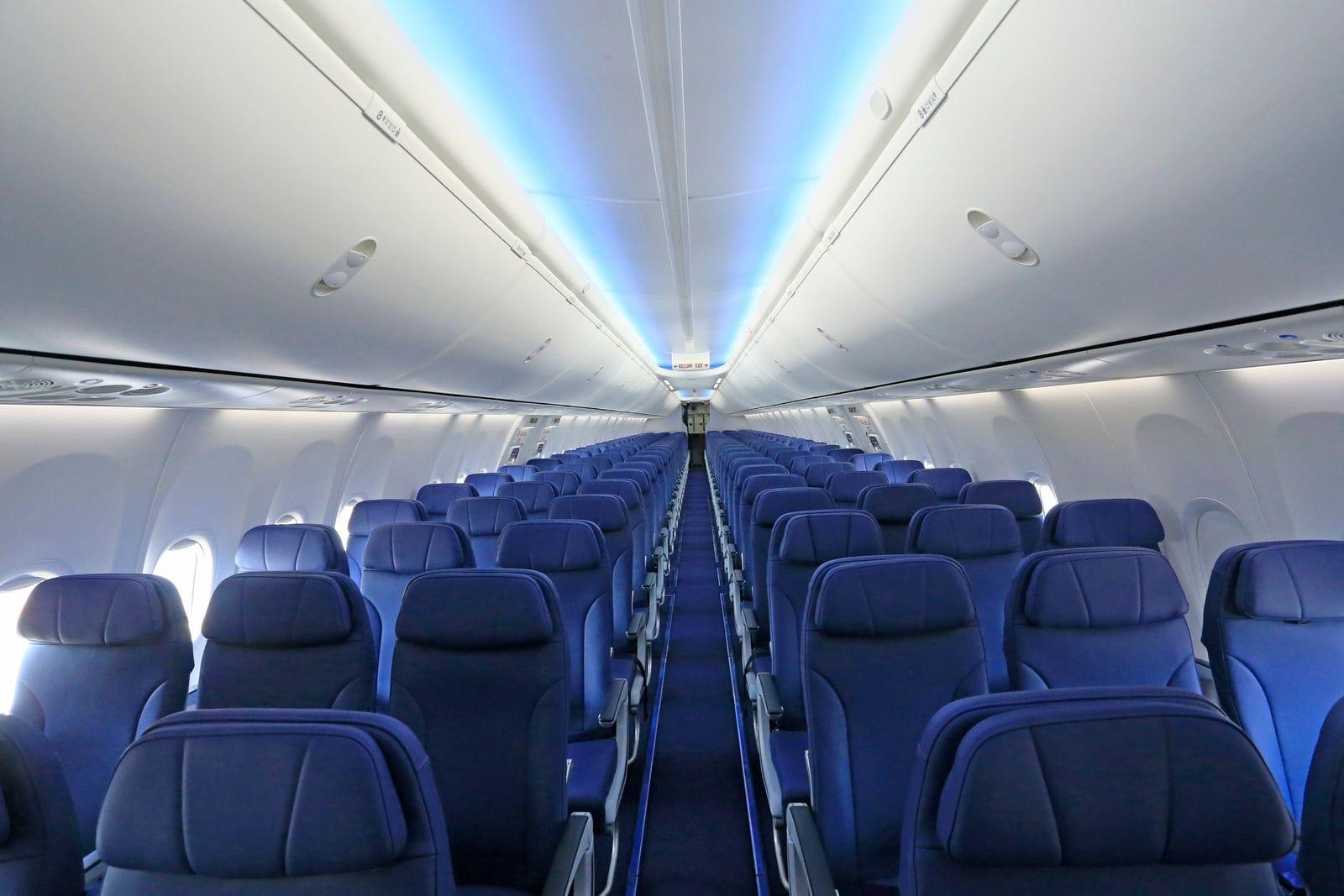
A single-aisle cabin. The carpet between the seat rows is often only around 17 to 20 inches wide, and narrower at the seat bases. The 12-inch TM3 is the CRB for this aisle. Measure the clearance at floor level between the seat frames before you buy, because the machine housing is wider than the brush. A low-moisture CRB pass also keeps wet extractor hoses out of the cabin. Keep the 15-inch TM4 for airline lounges and open premium-cabin floor. Photo: Pexels, free license.
The facility challenge
Short turns leave no time for wet work
A narrow-body turn at the gate gives cabin crews minutes, not hours. That window is for trash, seat pockets, lavatories, and spot cleaning. Nobody extracts an aisle carpet during a turn, and nobody should. The real carpet work happens on the overnight, when the aircraft remains on the ground, and during scheduled heavy checks.
The overnight is still short. A carpet that is damp at the first departure of the morning is a slip risk on the jet bridge side, a smell in a closed cabin, and a delay if someone decides it has to dry before boarding.
Water belongs nowhere near the floor panels
Cabin carpet sits on floor panels, over seat tracks and structure. Water that runs through the carpet and backing does not evaporate the way it does in a ventilated office. Maintenance teams treat standing moisture under the cabin floor as a corrosion and odor problem. A cleaning method that soaks the aisle creates work for the hangar.
Spills are the daily soil
Coffee, soda, juice, and meal-service food land in the same places every flight: the aisle beside the galley, the first rows behind each galley, and the seat rows where service carts stop. Those spots set into stains when they wait for the next deep clean.
Terminals and lounges never close
On the airport side, gate holdrooms, airline lounges, and concourse carpet see traffic from the first bank to the last. Closing a section to dry is a cordon that passengers walk around, or through.
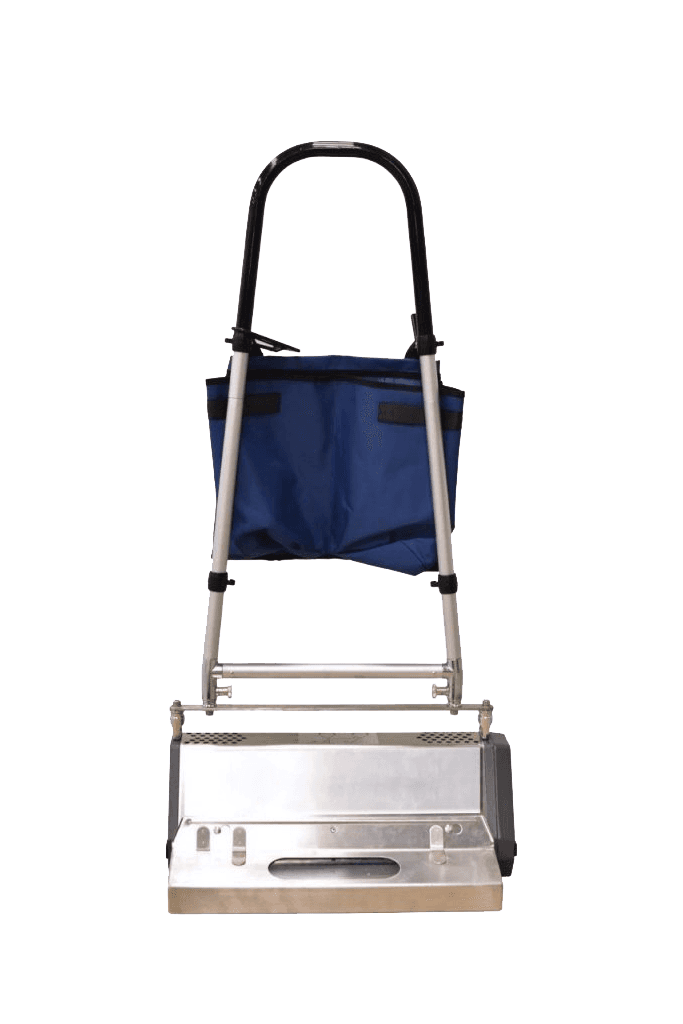
The TM5 20-inch covers the long, open runs of a gate holdroom or concourse in fewer passes than the cabin machine.
The CRB system solution
Which machine goes where
| Area | Machine | Why |
|---|---|---|
| Cabin aisles, galley approaches, crew rest | TM3 12-inch, about 40 lb | The narrowest CRB deck. One person carries it up the stairs or down the jet bridge. |
| Airline lounges, premium cabin areas with open floor | TM4 15-inch, about 56 lb | CRB's usual commercial width, still maneuverable between furniture. |
| Gate holdrooms, concourse carpet, crew rooms | TM5 20-inch, about 62 lb | Faster on long, open runs between seating banks. |
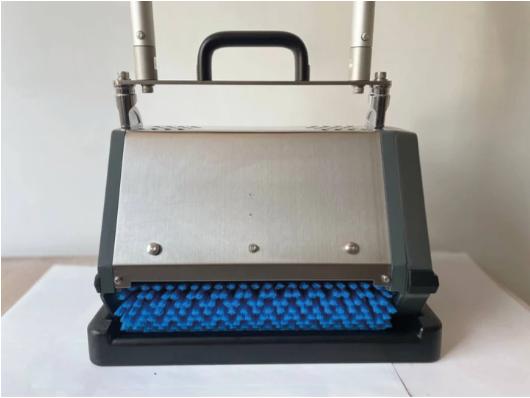
The TM3 12-inch is the narrowest CRB deck and the one to measure against an aisle. The handle on the housing is how one person carries it up the stairs or down the jet bridge.
Measure the aisle at floor level on each aircraft type before you buy. Aisle widths differ between types and cabin layouts, and the machine housing is wider than the brush.
The overnight sequence
- Vacuum the aisle and galley approaches with the cabin vacuum.
- Spot coffee, beverage, and food spills with a spotter. CRB's Ultra Pro beverage, enzyme, and general spotters are listed for this soil, and CRB states that they meet EPA Design for the Environment (DfE) criteria.
- Encapsulate or compound. A light encapsulating spray for routine appearance, or Ultra Pro Organic Dry Compound where the aisle has to be dry fastest. CRB states a dry time of about 40 minutes or less for the compound.
- Brush with the TM3. The two cylindrical brushes turn against each other, lift the pile, and work the chemistry through it.
- Vacuum once the floor is dry to the touch, to remove the crystals or the spent compound.
The method uses a small fraction of the water an extractor puts into carpet. CRB describes it as about 85 to 90 percent less water than traditional wet cleaning. Treat that as the manufacturer's comparison, and test it on your own aircraft and your own humidity.
Chemistry approval comes first
Aircraft operators control which chemicals touch the cabin. Many work from the airframe manufacturer's approved cleaning products list or their own engineering approval. CRB does not publish an aircraft approval for its chemistry. Before the first pass, send the SDS and the product data for the encapsulator, the compound, and the spotters to your engineering or materials group, and get written approval for each product on each aircraft type. Carpet in a cabin also has to keep meeting the aircraft's flammability requirements, so ask the carpet supplier whether the chemistry affects that.
On the airport side, approval is the normal facility process: SDS on file, product names on the cleaning log.
Before & after // process comparison
What happens under the carpet
A // Hot-water extraction
B // CRB low-moisture + pile lift
Diagram, not to scale. Water use per CRB: about 85–90% less than traditional wet cleaning.
Find your machine in 3 questions
Machine Selector
Find the right CRB machine in 3 questions
What kind of space do you clean most?
Pick the one that describes the majority of your route.
Operational ROI
The return comes from three numbers you can measure yourself. Do not accept a projected saving, from CRB or anyone else, that you cannot rebuild from your own logs.
- Minutes per aircraft. Time a TM3 pass on one aisle, overnight, with a normal operator pace. Compare it with the current method, including any drying wait before the cabin is released.
- Release delays. Count how often a damp or freshly cleaned carpet held up cabin release or the first boarding. A method that does not leave the aisle wet removes that line from the delay report.
- Deep-clean interval. Interim CRB cleaning keeps traffic lanes acceptable between extractions or carpet replacements. If spot-and-encapsulate keeps the aisle presentable one cycle longer, that is fewer heavy cleans and fewer early carpet changes.
A worked example for your own budget: multiply minutes saved per aircraft by the overnight fleet count and the labor rate, then add the cost of delays you no longer log. Use the real numbers from a trial, not the example.
What to ask before you buy
- Will the machine fit the aisle at floor level on every type you operate?
- Which CRB products has your engineering group approved, and for which aircraft?
- What dry time do you get in a closed cabin at overnight humidity? Test the worst case.
- Who carries the machine up the stairs or down the jet bridge, and where is it stored between aircraft?
- For the terminal: which areas can be cleaned in sections while open, and which need a night closure?
CRB can quote a TM3 for cabins and a wider machine for the terminal on the same order. Ask for both, and ask for the square-feet-per-hour figure on your floor before you size the fleet.
Related reading
Interactive configuration tools // size the system for this facility
Next step
Run the trial on your own floor
A CRB representative can demonstrate on your worst room or aisle, then price the machines, brushes, and chemistry for every site.