
03 // Industry Use Cases
Schools & Universities: Evening Carpet Care Without Wet Floors
A school floor has to be clean, dry, and documented by 7 a.m. Low-moisture cleaning with a counter-rotating brush fits the evening shift, and the SDS packet is what wins the bid.
At a glance
- Dry time
- ~40 minwith CRB Dry Compound
- Moisture method
- Low-moisture encapsulation / dry compound
- Recommended brush
- Standard BlueStiff Green
- Ideal machine
- TM3 (12") classrooms · TM4 (15") / TM5 (20") hallways
The 3-step process
- 1
Apply compound or encap pre-spray
A light, even application. No flooding, no soaked backing.
- 2
Counter-rotating cylindrical agitation
Two brushes turn against each other, lifting the pile and working chemistry in.
- 3
Lift soil & back in service
Vacuum the captured soil and reopen the space, often the same shift.
CRB vs. traditional wet extraction & rotary
| ✓ CRB low-moisture | Wet extraction / rotary | |
|---|---|---|
| Dry time | About 40 min or less with CRB dry compound | Soaked carpet can still be damp the next morning |
| Water in the floor | About 85–90% less water (CRB's comparison) | Floods the pile and backing |
| Wick-back & odor | Far less moisture left to wick back or sour | Moisture in the backing can wick, brown, or smell |
| Pile & surface | Cylindrical brushes lift and groom the pile | Rotary pads can distort pile; CRI 204 advises against rotary on carpet |
| Equipment | 40–62 lb, standard outlet, fits a closet or van | Truck access or portable extractor with hoses and tanks |
Keep a periodic hot-water extraction for heavy, oily, or salt-loaded soil. Dry time depends on humidity, airflow, and application rate.
Schools and universities use low-moisture carpet cleaning because the building reopens in the morning, and every floor has to be dry, safe, and defensible to a facilities director and a parent. Cleaning with a counter-rotating brush (CRB) and a light encapsulator or absorbent compound does the appearance work in the evening, without leaving damp carpet in a classroom or a wet floor in a hallway.
CRB lists schools among its customer segments. This page is the education case: where the soil comes from, which machine fits which room, what documentation a district asks for, and how to measure whether the program pays. The method is explained in What is dry cleaning.
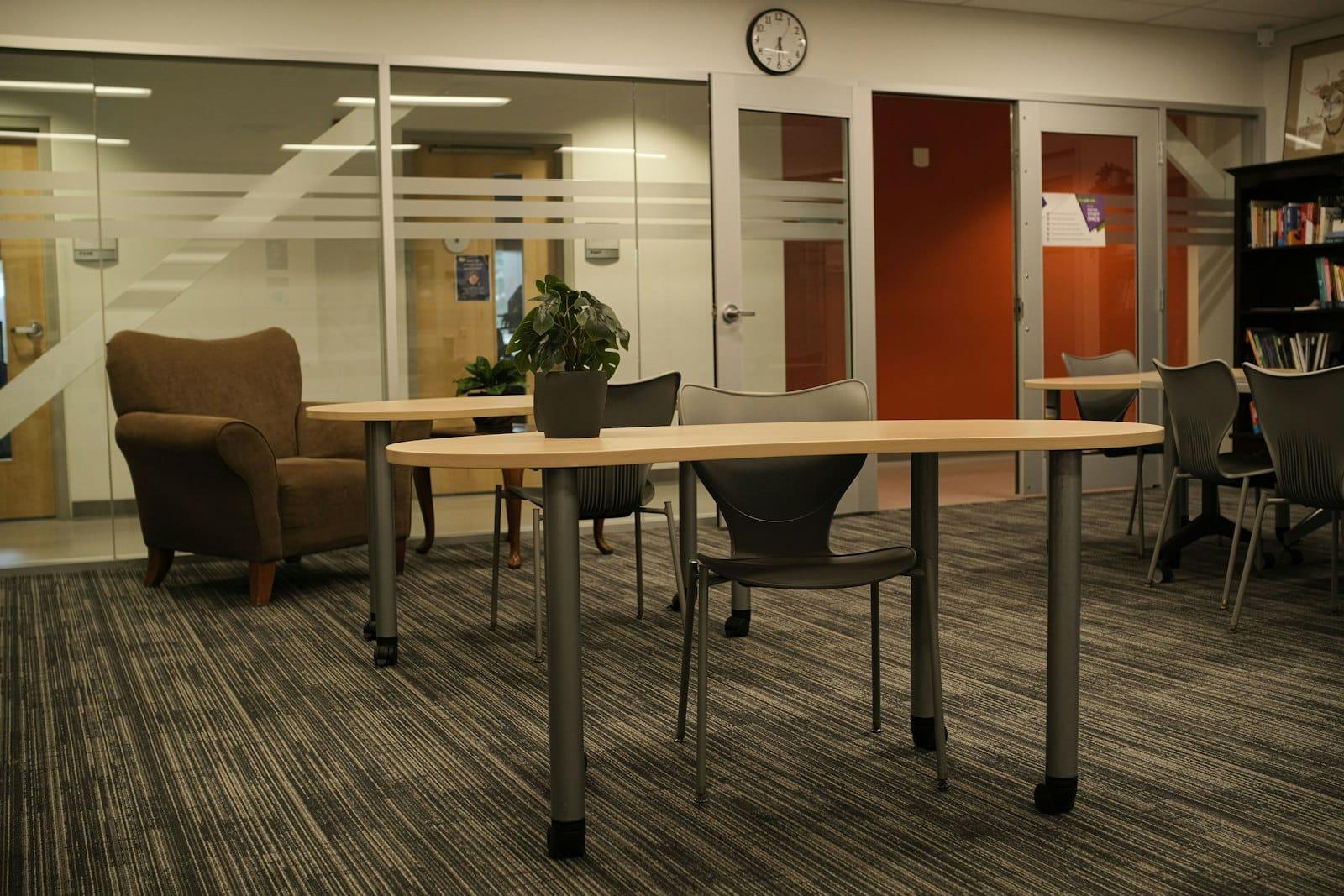
Low-pile commercial carpet tile in a university study area. In-house custodial teams run the 20-inch TM5 on wide corridors and open library floors, the 15-inch TM4 in hallways and libraries like this one, and the 12-inch TM3 between classroom desks. Encapsulation or dry compound leaves the carpet dry enough to walk on before morning, with no wet-floor slip risk. It also keeps water out of the tile backing and adhesive, where excess moisture is a known cause of delamination and adhesive release, especially in humid summer months. Photo: Allen Y, Unsplash.
The facility challenge
Soil arrives on hundreds of shoes, twice a day
Entries, the hallways off them, and the classrooms nearest the doors take the grit. Cafeteria approaches add food and drink. Libraries and offices carry less soil and more expectation. A single schedule for the whole building cleans some rooms too often and the entries too rarely.
The building has to be dry at opening
Custodial crews work in the evening and overnight. A carpet that is still damp at 7 a.m. smells in a closed classroom, wicks soil back up as it dries, and gets walked on before it is ready. Extraction has its place, usually in summer and during breaks, when rooms can stand empty. During the term, the method has to be dry by morning.
Slip risk is a liability, not an inconvenience
Wet-floor signs in a hallway at dismissal do not stop a running student. Cleaning that leaves hard floors or carpet edges wet near transitions is a claim waiting to happen.
Chemistry has to be documented
Districts and universities ask for documents, not adjectives. Several U.S. states have green-cleaning requirements for schools, and many districts have their own approved-product lists. The SDS, the certifications, and the dilution have to be on file before a product goes into a custodial closet.
The CRB system solution
Which machine goes where
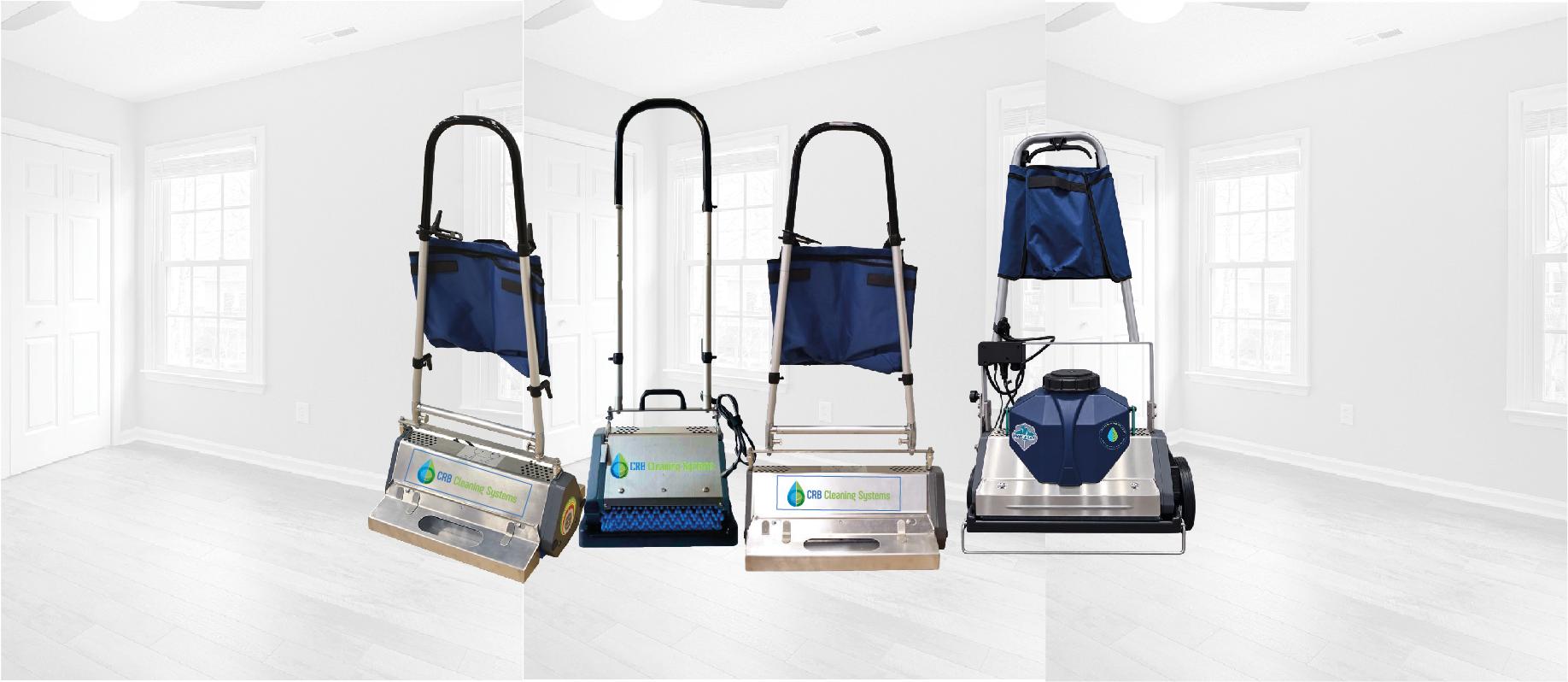
CRB machines come in 12-, 15-, and 20-inch widths. A district usually needs more than one: a narrow deck for classrooms and stairs, a wider one for corridors.
| Area | Machine | Why |
|---|---|---|
| Classrooms with desks, offices, stairs | TM3 12-inch, about 40 lb | Works between desk legs and around furniture. Extra handle for stairs. |
| Hallways, libraries, mixed rooms | TM4 15-inch, about 56 lb | CRB's usual commercial width. Balances coverage with maneuverability. |
| Long corridors, gyms with carpeted areas, auditorium aisles, open floors | TM5 20-inch, about 62 lb | Fewer passes on long, open runs. |
| Very large empty floors during breaks | Tandem 15- or 20-inch | Roughly twice the brush width per pass, on open floor only. |
Most districts that bring this in-house want a 15-inch machine per building and a 12-inch for classrooms and stairs, with a 20-inch shared between the larger sites. The tandem setup is explained in Large-scale corridors and convention centers.
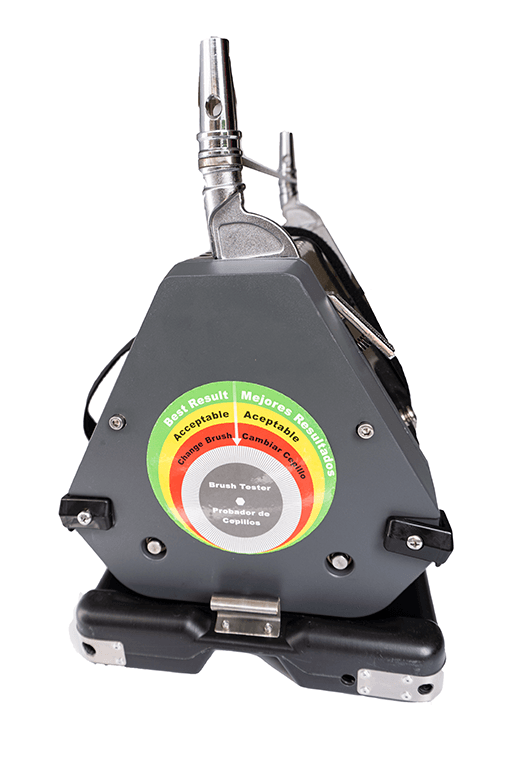
The brush tester on the housing shows when a brush is due for replacement. On a district fleet, it is the custodian's check at the start of each shift.
The evening sequence
- Vacuum entries, hallways, and classrooms on the daily schedule.
- Spot food, drink, and marker. Gum is a separate task: remove it with a gum remover or freezing before the machine pass. The brush will not lift it and can spread it.
- Encapsulate or compound by traffic: entries and hallway lanes weekly, classrooms on a longer cycle.
- Brush with the CRB. The counter-rotating brushes lift the pile and work the chemistry through it.
- Vacuum when dry. Encapsulation crystals and spent compound come out on the next vacuum, often the following evening.
CRB describes the method as using about 85 to 90 percent less water than traditional wet cleaning, and states a dry time of about 40 minutes or less for its Ultra Pro Organic Dry Compound. Treat those as the manufacturer's figures. Test the worst room you have, with the HVAC on its night setback.
Academic-year carpet maintenance schedule
How K-12 and university custodial teams pair daily vacuuming with CRB low-moisture interim maintenance. Set the cycles by traffic, and adjust them after the first term.
| Cycle | Campus zones | Method and CRB setup | Operational goal |
|---|---|---|---|
| Daily | Entrances, corridors, cafeterias | Walk-off mat and lane vacuuming, plus spotting with Ultra Pro spotters | Stop dry grit before it grinds into the carpet |
| Weekly to monthly (evening shift) | Main hallways, libraries, admin offices, lecture halls, classrooms | TM5 20-inch on long corridors, TM4 15-inch in hallways and libraries, TM3 12-inch in classrooms, with Ultra Pro peroxide encapsulation | Lift compacted traffic lanes, dry before the morning bell |
| Spills and accidents | Classrooms, dorm rooms | UV inspection light to find the spot, enzyme spotter, then TM3 12-inch with Ultra Pro Organic Dry Compound (CRB states about 40 minutes or less to dry) | Treat the spot without pushing new water into the backing, and keep the room open |
| Summer and winter break | Campus-wide restorative reset | CRB pass to open the pile and pre-treat lanes, then hot-water extraction only where the carpet needs it | Fewer rooms on the extraction list, and less water and drying time over the year |
Body-fluid incidents follow the district's bloodborne-pathogens procedure first. The carpet clean comes after that cleanup, not instead of it.
Hard floors on the same machine, with care
The blue brush maintains ceramic and porcelain tile, and the green brush is for rougher grout, as explained in Dry cleaning for tiles. Many schools also have finished resilient floors, such as VCT with a floor finish. Those follow the finish program. Do not put a stiff brush on a finished floor without testing a corner first.
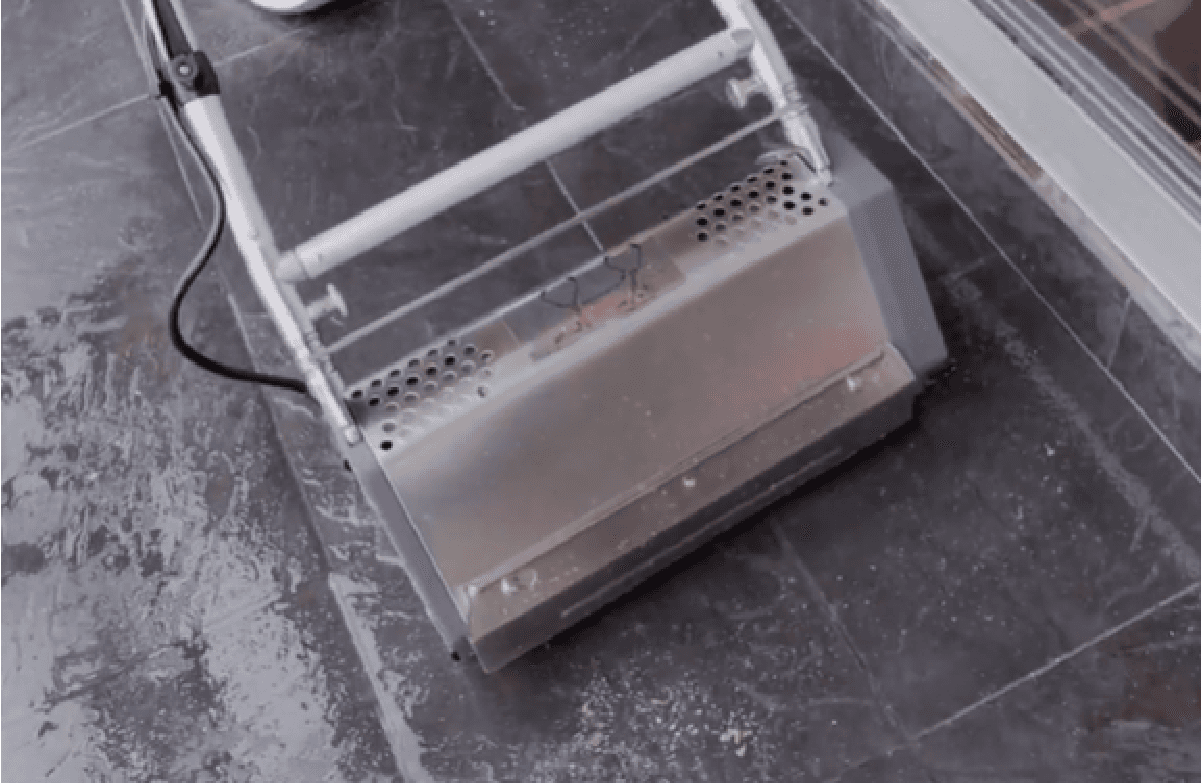
The same machine with a hard-floor brush works ceramic and porcelain tile in entries and restrooms. Finished resilient floors stay on their finish program.
What goes in the documentation packet
- Ultra Pro encapsulation pre-spray: CRB states it is CRI certified and hydrogen-peroxide based. The SDS for the concentrate lists it as a skin and eye irritant as sold. Mixing stays in the custodial closet, with gloves and eye protection.
- Ultra Pro Organic Dry Compound and the spotters: CRB states they meet EPA Design for the Environment (DfE) criteria.
- The SDS for each product, the dilution chart, and the label. The SDS downloads are on the resources page.
Send the packet with the bid. A facilities director comparing two vendors will pick the one whose paperwork is already complete.
Before & after // process comparison
What happens under the carpet
A // Hot-water extraction
B // CRB low-moisture + pile lift
Diagram, not to scale. Water use per CRB: about 85–90% less than traditional wet cleaning.
Find your machine in 3 questions
Machine Selector
Find the right CRB machine in 3 questions
What kind of space do you clean most?
Pick the one that describes the majority of your route.
Operational ROI
Build the return from your own buildings. Three measurements are enough for a pilot.
- Square feet per evening, per custodian. Time one hallway and one furnished classroom with a normal operator pace. That number sizes the fleet and the labor.
- Morning complaints. Count damp-carpet, odor, and wet-floor reports from the first period for a month before and after.
- Extraction frequency. If interim CRB cleaning keeps traffic lanes presentable until the summer extraction, instead of needing a mid-year deep clean, that is a contractor visit or a weekend of overtime saved.
Multiply the hours saved by the custodial rate, add the extraction visits you no longer schedule, and compare that with the machine and chemistry cost over the carpet's remaining life.
Find your brush in 2 questions
Step 1 of 2
What a district should ask before buying
- Which floors are carpet, which are tile, and which are finished resilient? Each one gets a different brush or no brush.
- Are the products on your state or district approved list? Get it in writing.
- Who trains the evening crew, and on which video? CRB's assembly and brush installation videos are the right first shift.
- Where are the machines stored, and do the buildings share a wider machine?
Related reading
Interactive configuration tools // size the system for this facility
Next step
Run the trial on your own floor
A CRB representative can demonstrate on your worst room or aisle, then price the machines, brushes, and chemistry for every site.