
01 // Core Cleaning Methods
What Is Dry Cleaning for Carpets and Floors?
In floor care, dry cleaning means very little water: an encapsulating solution or an absorbent compound, worked in with a counter-rotating brush, then vacuumed out.
At a glance
- Dry time
- ~40 minwith CRB Dry Compound
- Moisture method
- Low-moisture encapsulation / dry compound
- Recommended brush
- Soft GrayStandard BlueStiff Green
- Ideal machine
- TM3 (12") / TM4 (15") / TM5 (20")
The 3-step process
- 1
Apply compound or encap pre-spray
A light, even application. No flooding, no soaked backing.
- 2
Counter-rotating cylindrical agitation
Two brushes turn against each other, lifting the pile and working chemistry in.
- 3
Lift soil & back in service
Vacuum the captured soil and reopen the space, often the same shift.
CRB vs. traditional wet extraction & rotary
| ✓ CRB low-moisture | Wet extraction / rotary | |
|---|---|---|
| Dry time | About 40 min or less with CRB dry compound | Soaked carpet can still be damp the next morning |
| Water in the floor | About 85–90% less water (CRB's comparison) | Floods the pile and backing |
| Wick-back & odor | Far less moisture left to wick back or sour | Moisture in the backing can wick, brown, or smell |
| Pile & surface | Cylindrical brushes lift and groom the pile | Rotary pads can distort pile; CRI 204 advises against rotary on carpet |
| Equipment | 40–62 lb, standard outlet, fits a closet or van | Truck access or portable extractor with hoses and tanks |
Keep a periodic hot-water extraction for heavy, oily, or salt-loaded soil. Dry time depends on humidity, airflow, and application rate.
In carpet and hard-floor care, dry cleaning is a very-low-moisture method. A small amount of encapsulating solution, or a moist absorbent compound, is worked through the surface with a counter-rotating brush (CRB). The soil is then vacuumed away. The floor is returned to use far sooner than after a hot-water extraction.
Most people first hear “dry cleaning” as the solvent process used on suits and dresses. That is a different trade. This guide is about floors: commercial carpet, carpet tile, and hard surfaces such as ceramic tile and grout. It is written for facility managers, hotel engineers, and cleaning companies deciding whether a low-moisture system belongs in the building.
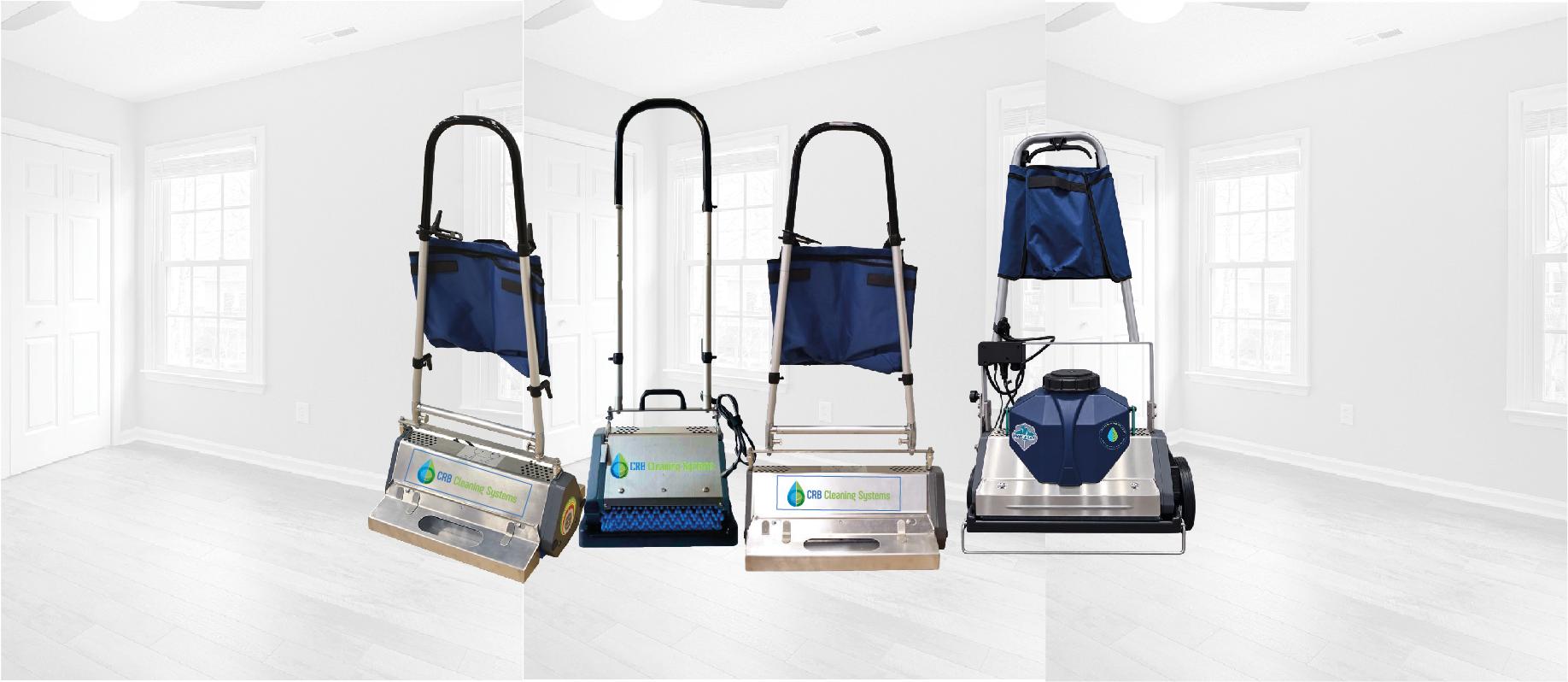
CRB machines are built for low-moisture cleaning of carpet and hard floors. Widths are 12, 15, and 20 inches, with an optional onboard solution system.
What “dry” means on a floor
Dry, in this industry, means very low moisture. Encapsulation uses a light spray. Absorbent compound is damp when it goes down. Both use a small fraction of the water a truck-mounted extractor puts into a carpet.
CRB describes its equipment as using about 85 to 90 percent less water than traditional wet cleaning. Treat that as the manufacturer’s comparison with wet extraction. Drying time on a real floor still depends on humidity, airflow, pile height, and how heavily the solution was applied.
The practical result is the one buyers feel: a guest room, corridor, or open office can be cleaned and put back into service on the same shift, in conditions where a soaked carpet would still be damp the next morning.
The methods that get called dry cleaning
People use one name for several processes. They are related, and they are separate tools.
Absorbent compound
A moist, absorbent compound is spread on the carpet and brushed through the pile. Soil transfers into the particles. The spent compound is vacuumed out. CRB’s Ultra Pro Organic Dry Compound is in this family. CRB describes it as made from organic, recycled material, meeting EPA Design for the Environment (DfE) criteria, with a citrus scent. The compound is yellowish and darkens as it loads soil. CRB states a dry time of about 40 minutes or less. It is used on carpet and on hard floors, often together with encapsulation on traffic lanes.
Encapsulation
A polymer detergent is applied lightly. As it dries, the polymer surrounds soil in brittle crystals. The next vacuuming removes those crystals. CRB’s main product for this is Ultra Pro peroxide encapsulation pre-spray. CRB states that it is CRI certified, low moisture, hydrogen-peroxide based, floral or lavender in scent, and leaves no sticky residue. The published shelf life is about six months. The safety data sheet for the concentrate lists a pH of about 4 to 5 and classifies the product, as sold, as a skin and eye irritant. Use the dilution on the label, and read the SDS before staff handle the concentrate.
Encapsulation is the method the Carpet and Rug Institute builds its interim-maintenance definition around. In CRI 204, the commercial carpet standard, an interim maintenance system is an encapsulating solution, a counter-rotating brush, and a vacuum. The goal is appearance: keep traffic lanes acceptable and postpone the next deep cleaning.
Bonnet cleaning
Bonnet cleaning sprays a solution and picks soil up into a cotton or microfiber pad on a rotary machine. It can refresh the surface of a level commercial carpet quickly. It is a different machine, with a horizontal spinning head. CRI 204 does not recommend rotary equipment for carpet cleaning, because that motion can distort pile. A counter-rotating brush uses cylindrical brushes that lift the pile as they turn. If a quote says “dry cleaning” and the crew arrives with a rotary and a pad, ask which chemistry and which machine they mean.
Hot-water extraction
Extraction, often called steam cleaning, rinses the pile with solution and recovers it with suction. CRI 204 calls a vacuum, a solution, and an extractor a deep-cleaning system. It is the right reset when soil is heavy, oily, or loaded with winter salt, and when a carpet has gone a long time with only surface cleaning. It also puts more water into the backing. On carpet tile and in occupied hotels, that water is the reason many buildings keep extraction on a longer cycle and do the in-between work with a CRB.
A sound program uses both ideas. Vacuum and spot every day. Run encapsulation or compound on a schedule matched to traffic. Plan a true deep cleaning when appearance, odor, or soil load says the interim work is no longer enough.
What the brush actually does
Low-moisture chemistry cannot float soil out of a carpet the way a flood of water can. Something has to open the pile and bring the detergent into contact with the fiber. That something is agitation.
CRI describes a counter-rotating brush as cylindrical brushes that spin in a way that lifts and agitates the pile. On a CRB machine the two brushes turn against each other. They comb the yarn, work the solution or compound through it, and stand the pile up. The same deck, with a stiffer brush, reaches into grout lines on ceramic and porcelain tile.
CRB builds that deck in three working widths:
- TM3, 12 inches. About 40 lb, 500 W, 110/220 V, 450 RPM. The extra handle and lower weight are meant for stairs, guest rooms, and tight offices.
- TM4, 15 inches. About 56 lb, 750 W (listed as 1 HP), 110/220 V, 380 RPM. CRB’s most common machine for homes, small offices, and obstructed commercial space.
- TM5, 20 inches. About 62 lb, 750 W, 110/220 V, 380 RPM. For open corridors, showrooms, and larger commercial floors.
- Tandem. Two 15-inch or two 20-inch machines joined, for very large open areas. The gain shows up where the operator can walk a long, straight path.
All of them are listed at about 42.5 inches tall, so they fit a closet or a van. The 2026 brochure lists a one-year warranty on the machine and two years on the motor. Confirm the warranty card that ships with the unit you buy.
The listed wattage is in the range of a normal commercial outlet. In an older hotel or office, put the machine on a circuit that is not already feeding heaters or other floor equipment.
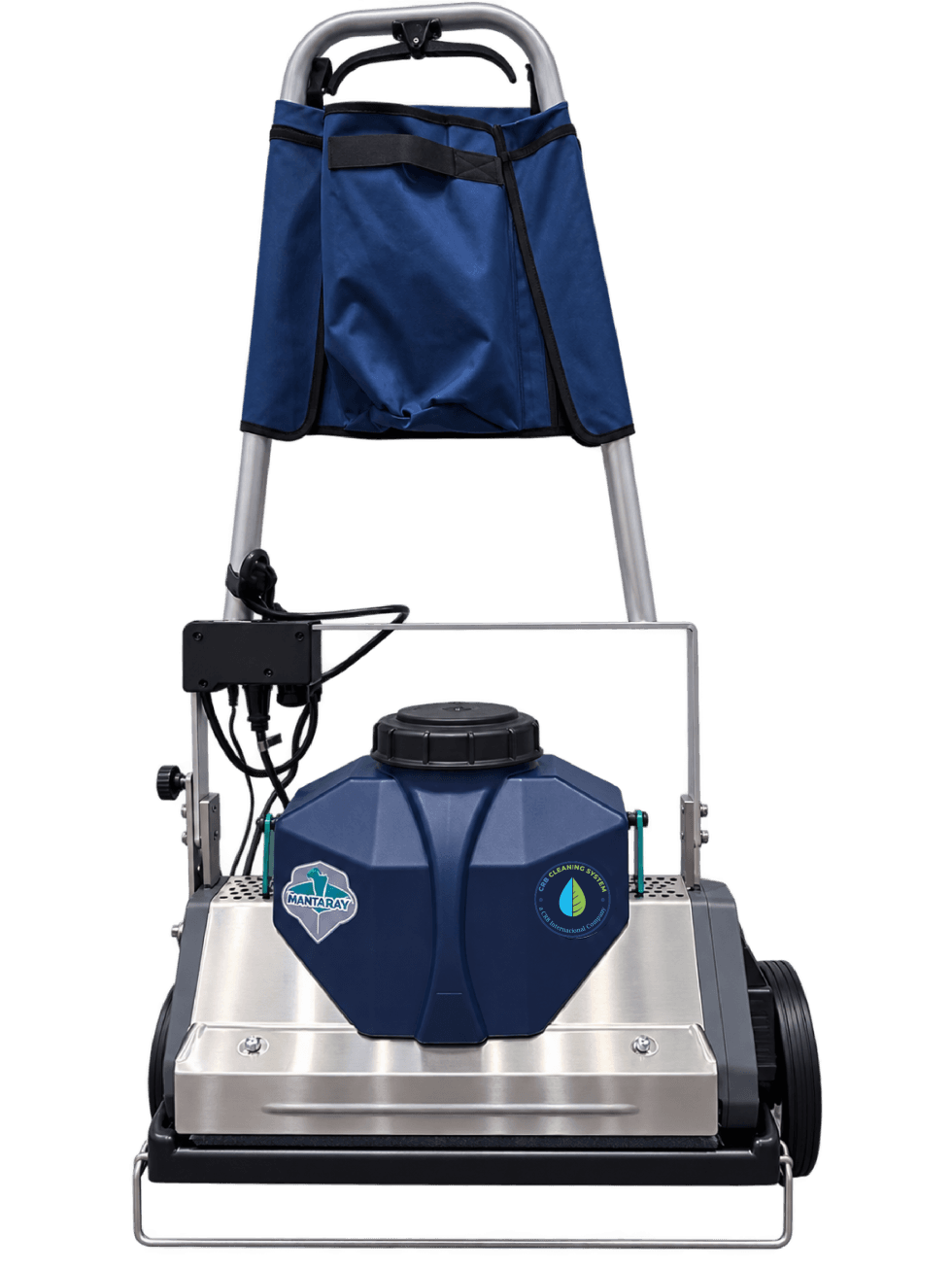
The Manta Ray is CRB’s onboard solution system. The 2026 brochure describes a compact 2-gallon tank, internal delivery, and foam or liquid, for carpet and hard floors, on new or existing machines.
Solution can be applied with a pump sprayer. The Manta Ray puts a 2-gallon tank on the machine and feeds foam or liquid through the housing, so the operator is not spraying ahead of the pass. Confirm, when you order, whether the tank is included on that model. See it running: Meet the CRB Manta Ray.
Find your machine in 3 questions
Machine Selector
Find the right CRB machine in 3 questions
What kind of space do you clean most?
Pick the one that describes the majority of your route.
Chemistry that matches the machine
The machine is half of the system. Brushes and chemicals are the other half. CRB’s line is built to be used with these machines, and the company notes that some of the products are also used with other methods.
| Product | Job |
|---|---|
| Ultra Pro peroxide encapsulation | Routine low-moisture carpet cleaning. CRB states it is CRI certified. |
| Ultra Pro Organic Dry Compound | Traffic lanes and a drier timeline. CRB states DfE criteria and a dry time of about 40 minutes or less. |
| Ultra Pro spotters (general, beverage, enzyme) | Spills. CRB states the spotters meet DfE criteria. |
| ECO Luster Shine and ECO Luster Guard | Luxury vinyl tile. A different process from grout cleaning. |
Published low-moisture dilutions for the encapsulator, from CRB’s chemicals guide, are a starting point. The label on the container you have is the instruction for that batch.
- Medium soil: 6–10 oz per gallon of water
- Heavy soil: 10–14 oz per gallon
- Extreme soil: 14–20 oz per gallon
The same guide lists stronger spot-cleaning dilutions, lighter rates when the product is used in an extractor, and a 2 oz per gallon rinse-aid rate when a previously cleaned carpet has a sticky residue. Follow the current label.
Brush color is stiffness. White extra-soft is for delicate rugs. Gray soft is for residential cut pile and commercial wool, including many hotel carpets. Blue standard is the everyday commercial loop brush and is also used for lighter tile work. Green stiff is for rough floors and grout. Yellow extra-stiff is for unsealed concrete and outdoor patios, and for a one-time restorative pass on severely matted commercial low loop, only after the carpet mill has approved it. Keep it off routine indoor carpet cleaning of any kind. Some product-page wording for the 20-inch brushes does not match this chart. Confirm the SKU before you order a second set. Full pairing is in Dry cleaning for carpets.
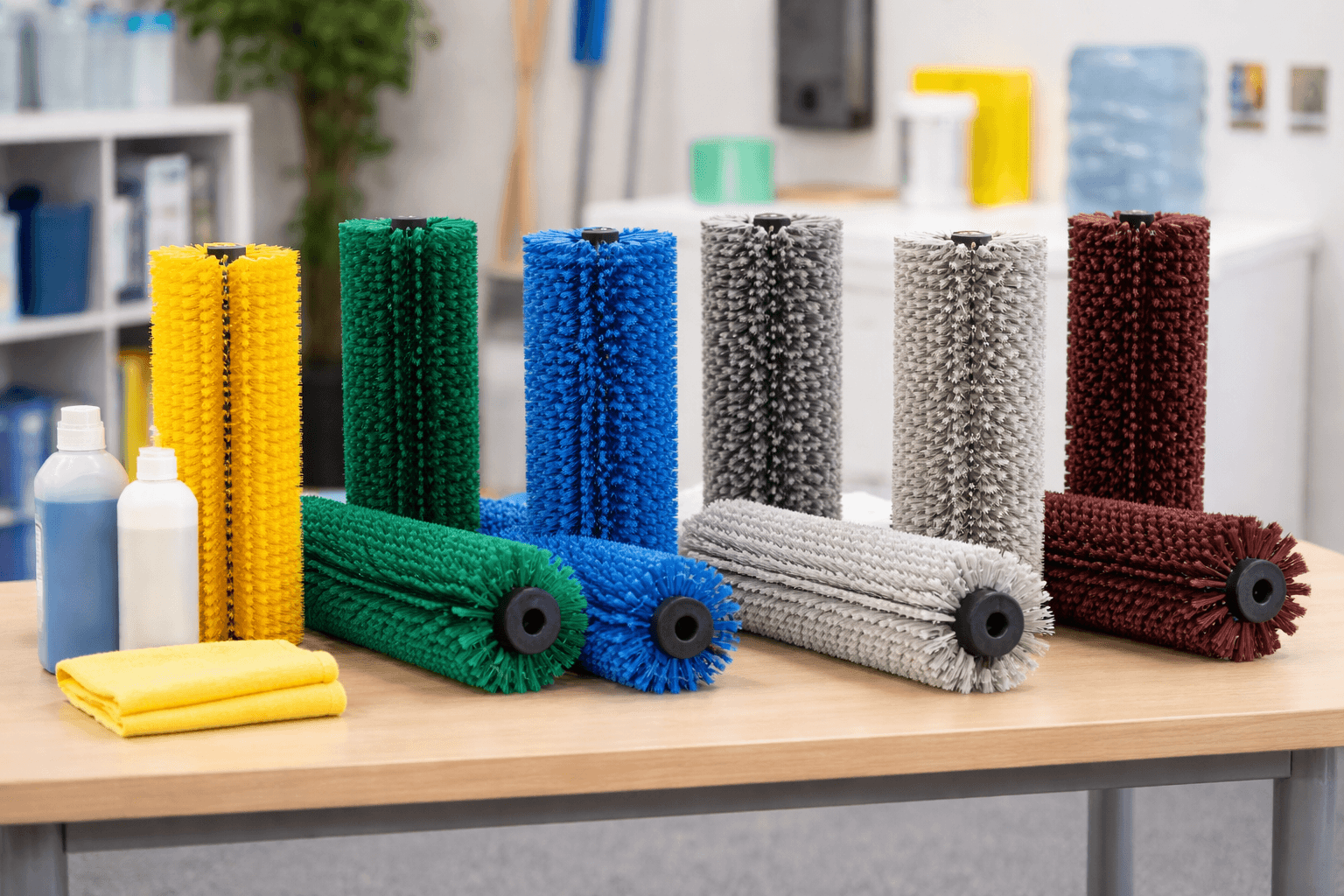
Brush color is stiffness. The blue brush is the usual commercial carpet brush. Green is the usual choice for grout and rough hard floors.
Find your brush in 2 questions
Step 1 of 2
Where this method earns its place
Low-moisture CRB cleaning fits floors that have to stay in service:
- Hotels and motels, where a wet guest-room carpet is an out-of-order room. See benefits for hotels.
- Offices, especially carpet tile, where excess water can sit in seams and adhesive. See benefits for offices.
- Schools, senior housing, athletic facilities, and airlines. CRB already lists those as customer segments. The same limits on water and downtime apply.
- Cleaning companies that want a commercial service they can run from a car or a van, on a standard outlet, without arranging truck access.
It also fits hard floors. Tile and grout need agitation in the joint. A CRB with a green or blue brush does that work with a controlled amount of solution. That process is covered in Dry cleaning for tiles.
Where you should still plan an extraction
Use this test before you drop extraction from the program.
Choose a deep cleaning when:
- Traffic lanes are dark after a competent vacuum and an interim cleaning.
- The carpet smells musty, or a moisture meter says the backing or cushion is wet.
- Entry carpet is loaded with salt, oil, or parking-lot soil.
- Spots keep returning in the same place. That is often soil left under the fiber, or a spill that was never fully treated.
- You are documenting a restorative clean for a warranty or a property turnover.
Choose low-moisture CRB work when appearance has to hold between those resets, when the floor is carpet tile or glue-down, when the building is occupied, or when the last extraction left odor, browning, or long dry times.
A first-time dry cleaning on a wool carpet that has never been cleaned this way can raise fuzz. CRB’s own brush guidance says so, and recommends the gray soft brush for hotel wool, with a test pass. Peroxide chemistry can affect some dyes. Test colorfastness in a closet or under a movable piece of furniture.
Yellow brushes, and any aggressive pass on a textured loop, belong in a conversation with the carpet manufacturer. CRI’s Seal of Approval program exists in part because many carpet warranties expect approved products and methods. Ask the mill what they require, and keep the product name on the work order.
A simple way to explain it to a customer
If you sell the service, the accurate sentence is short.
“We vacuum the dry soil, treat spots, apply a low-moisture encapsulator or compound, brush it through with a counter-rotating machine, and vacuum the soil back out. You can use the room again much sooner than after a steam clean. Once or twice a year, or whenever the carpet is truly loaded, we still recommend a deep extraction.”
That sentence sets the right expectation. It also explains why the chemicals are not optional. A brush with water alone is agitation. The polymer or the compound is what holds the soil so vacuuming can remove it.
Watch the method
These are on CRB’s own channel, CRB Cleaning systems:
- Introducing the TM3, the 12-inch machine
- TM4 15-inch in action
- How to assemble the machine
- How to install the brushes
- Manta Ray overview
Related reading
- Dry cleaning for carpets
- Dry cleaning for tiles
- Dry cleaning benefits for hotels
- Dry cleaning benefits for offices
- CRB machines
- Chemicals
- Brushes
FAQ
Is dry carpet cleaning the same as dry cleaning a suit?
No. Garment dry cleaning uses solvents in a specialized machine. Floor dry cleaning uses very little water, a detergent system made for carpet or hard floors, and a counter-rotating brush.
Does the carpet get wet at all?
Yes, slightly, if you use encapsulation. Compound cleaning is damper than a dry vacuum and much drier than extraction. The aim is a floor that can go back into service on the same shift.
Can low-moisture cleaning replace steam cleaning forever?
On many commercial schedules it does the majority of the appearances cleans. A periodic hot-water extraction is still the deep reset for heavy, oily, or salt-loaded soil.
Which machine should a new cleaning company buy first?
The TM4 15-inch is the width CRB describes as the usual first machine for homes and small commercial work. Add a 12-inch if stairs and small rooms are the job, or a 20-inch if the work is open and unobstructed.
Are the chemicals required?
The machine agitates. The encapsulator, compound, and spotters are what detach and hold soil so it can be vacuumed. CRB formulates them for this equipment. Using an unknown detergent risks residue, which attracts more soil.
Talk with CRB
CRB Cleaning Systems manufactures the machines, brushes, and chemicals as one system, and supplies customers in more than 18 countries. For help matching a width and a chemistry to a building, call 1-800-704-0527 or email info@crbclean.com.
Interactive configuration tools // apply this guide to your floor